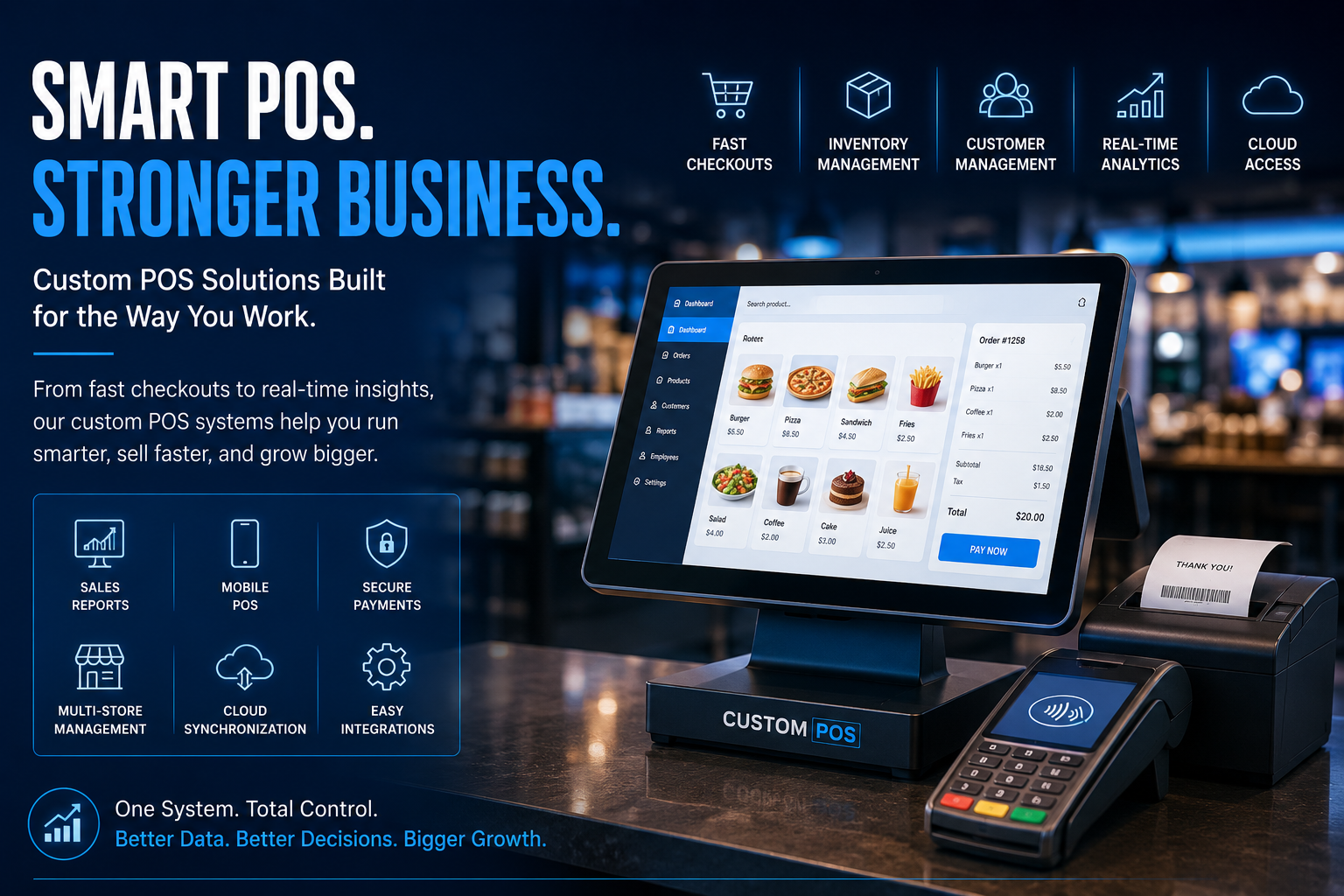
Point-of-sale systems have come a long way from simple cash registers.
Today, a modern POS system can manage payments, inventory, customer relationships, employees, reporting, online orders, and much more—all from a connected digital platform.
As businesses become more technology-driven, custom POS software development is becoming an important strategy for companies that need more flexibility than traditional off-the-shelf solutions can provide.
What Is a Modern POS System?
A modern POS system is more than a tool for processing transactions.
It acts as a central platform connecting different parts of a business.
A typical solution may include:
- Payment processing
- Inventory management
- Sales reporting
- Customer management
- Employee management
- Product management
- Online ordering
- Loyalty programs
- Multi-location management
- Accounting integrations
- Real-time analytics
By bringing these functions together, businesses can gain better visibility into daily operations.
Why Businesses Are Moving Toward Custom POS Software
Every business has different workflows.
A restaurant may need table management and kitchen integration. A retail business may require barcode scanning and inventory synchronization. A multi-location enterprise may need centralized reporting and location-level controls.
Generic POS software may not always fit these requirements.
Custom POS development allows businesses to build functionality around their actual operations instead of changing their workflows to fit a software product.
Key advantages include:
Greater flexibility: Build features specifically for your business.
Better integrations: Connect the POS with existing business systems.
Scalability: Add functionality as the company grows.
Improved customer experience: Create faster and more personalized checkout experiences.
Better data visibility: Access business information through centralized dashboards.
Cloud-Based POS Is Changing Business Operations
Cloud technology has transformed how businesses access and manage POS systems.
With a cloud-based POS platform, authorized users can access important business information from different locations and devices.
For businesses operating multiple stores, this can make centralized management significantly easier.
Managers can monitor sales, inventory, and performance without needing to be physically present at every location.
Mobile POS Is Creating More Flexible Checkout Experiences
Customers increasingly expect fast and convenient transactions.
Mobile POS solutions allow businesses to process transactions using tablets, smartphones, or dedicated mobile devices.
This can be particularly useful for:
- Restaurants
- Retail stores
- Events
- Pop-up businesses
- Hospitality
- Delivery operations
Mobile POS can reduce dependency on fixed checkout counters and give employees more flexibility when serving customers.
AI and POS: From Transactions to Business Intelligence
One of the most interesting developments in POS technology is the integration of Artificial Intelligence.
AI can help businesses analyze large amounts of sales and operational data.
Potential applications include:
- Sales forecasting
- Demand prediction
- Product recommendations
- Customer behavior analysis
- Inventory optimization
- Automated reporting
- Personalized promotions
Instead of simply recording what happened, an intelligent POS system can help businesses understand why it happened and what may happen next.
Inventory Management Is Becoming Smarter
Inventory problems can directly affect profitability.
Too much inventory can increase storage costs, while insufficient inventory can result in missed sales.
Modern POS platforms can connect sales data with inventory systems to provide more accurate visibility into stock levels.
Businesses can use this information to identify fast-moving products, monitor inventory trends, and improve purchasing decisions.
POS Security Is More Important Than Ever
A POS system handles sensitive business and payment information, making security a critical consideration.
Modern POS development should take security into account across the complete technology stack.
Important areas include:
- Secure authentication
- Role-based access
- Encrypted communication
- Secure APIs
- Payment security
- Data protection
- Regular security testing
- Monitoring and logging
Security should be part of the architecture from the beginning rather than added after the system has already been built.
Multi-Location POS Systems
For growing businesses, managing multiple locations through separate systems can create unnecessary complexity.
A centralized POS platform can provide a unified view of business operations.
Organizations can potentially manage:
Locations + Products + Inventory + Employees + Customers + Sales + Reports
from one connected environment.
This can make it easier for management teams to compare locations and make data-driven decisions.
The Importance of POS Integrations
A POS system rarely works alone.
Modern businesses may need their POS to communicate with:
- Payment gateways
- Accounting software
- CRM platforms
- E-commerce stores
- Inventory systems
- Loyalty platforms
- Delivery services
- ERP systems
- Analytics platforms
Well-designed APIs and integrations can help create a connected business ecosystem instead of isolated software systems.
How Custom POS Developers Can Help
Custom POS Developers helps businesses develop POS solutions designed around their specific operational requirements.
Custom POS development can cover everything from restaurant and retail POS applications to mobile POS, cloud POS, payment integrations, inventory management, dashboards, and third-party system integrations.
The objective is not simply to create another billing application.
It is to build a technology platform that supports the way a business actually operates.
What Should Businesses Look for in a POS Development Partner?
Before selecting a development partner, businesses should consider:
Industry Experience
The development team should understand the operational requirements of the target industry.
Integration Expertise
A POS solution should be capable of communicating with the systems the business already uses.
Security Knowledge
Payment and customer data require appropriate security measures.
Scalability
The platform should be able to support future growth.
User Experience
Employees need an interface that is fast, simple, and intuitive.
Long-Term Support
POS software requires ongoing maintenance, updates, monitoring, and improvements.
What Does the Future of POS Look Like?
The POS industry is moving toward increasingly connected and intelligent systems.
The future may combine:
POS + AI + Cloud + Mobile + IoT + Analytics + Digital Payments
This convergence can create smarter retail and hospitality environments where businesses have access to real-time information and customers receive faster, more personalized experiences.
The POS system of the future won’t simply process transactions.
It will help businesses make better decisions.
Final Thoughts
POS technology is becoming a core component of modern business infrastructure.
For companies with unique workflows, multiple locations, specialized integrations, or ambitious growth plans, custom POS software can provide the flexibility needed to build a solution around their business.
The right POS platform can connect transactions, inventory, customers, employees, payments, and analytics into one powerful ecosystem.
The future of POS isn’t just about selling faster. It’s about operating smarter.
Comments