Introduction
The modern restaurant is no longer just a place where customers order food and pay the bill.
Behind every successful restaurant is a complex technology ecosystem managing orders, payments, inventory, employees, customers, delivery, reporting, and business performance.
At the center of this ecosystem is the restaurant POS system.
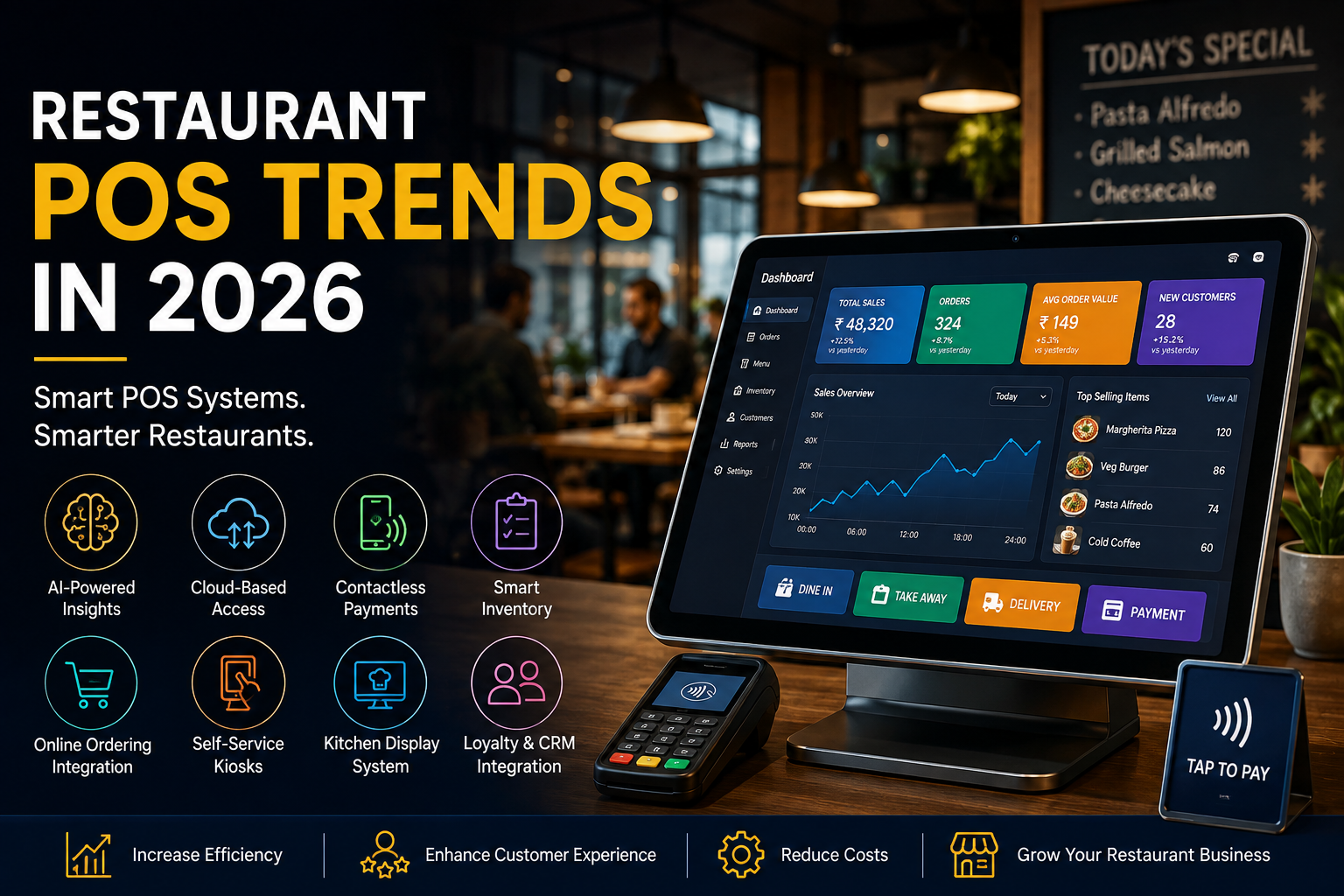
In 2026, POS technology is evolving beyond traditional billing. Restaurants are increasingly adopting intelligent systems that connect front-of-house operations with inventory, analytics, customer engagement, payments, and automation.
For restaurant owners and chains, choosing the right POS technology is no longer simply about processing transactions.
It is about creating a connected platform that can help the business operate faster, reduce errors, understand customers, and scale efficiently.
1. AI-Powered POS Systems Are Becoming Smarter
Artificial Intelligence is changing the way restaurants use their operational data.
Modern POS platforms can potentially use AI-powered analytics to identify patterns in:
- Sales
- Customer behavior
- Menu performance
- Ordering patterns
- Inventory consumption
- Peak hours
- Product demand
For example, a restaurant may discover that certain menu items consistently perform better during specific days or time periods.
AI-powered insights can help restaurant managers make better decisions instead of relying entirely on manual reports.
The goal is not simply to add an AI chatbot to a POS system.
The real opportunity is using AI to turn restaurant data into actionable business insights.
2. Cloud-Based POS Is Becoming the New Standard
Traditional POS systems often depended heavily on local hardware and on-site infrastructure.
Cloud-based POS systems provide restaurants with greater flexibility.
With cloud technology, authorized users can access business information across locations and devices.
Restaurant owners can potentially monitor:
- Daily sales
- Multiple locations
- Menu performance
- Inventory
- Employee activity
- Revenue trends
- Operational reports
This is particularly valuable for restaurant chains managing multiple outlets.
Instead of treating every location as a separate operation, businesses can create a more connected technology environment.
3. Multi-Location Restaurant Management Is Getting Easier
Restaurant chains need more than basic billing software.
They need centralized management.
A modern multi-location POS system can help businesses manage:
Head Office → Locations → POS → Inventory → Employees → Reports
Centralized systems can make it easier to maintain:
- Menu information
- Pricing
- Promotions
- Tax configurations
- User permissions
- Reporting structures
- Operational policies
At the same time, individual locations can maintain the flexibility needed for day-to-day operations.
4. Contactless and Digital Payments Continue to Grow
Customers increasingly expect convenient payment options.
Modern restaurants may support:
- Contactless card payments
- QR payments
- Mobile wallets
- Digital payment links
- Integrated card terminals
- Online payments
Integrating payments directly into the POS workflow can reduce manual steps and improve transaction accuracy.
The key is creating a payment experience that is fast for customers while remaining secure for the restaurant.
5. Inventory Management Is Becoming More Intelligent
Food waste can significantly affect restaurant profitability.
A POS system connected to inventory management can provide better visibility into ingredient consumption and product movement.
Restaurants can track:
- Stock levels
- Ingredient usage
- Purchase orders
- Wastage
- Menu item consumption
- Supplier information
- Reorder requirements
When POS and inventory data are connected, restaurants can better understand how sales affect stock.
This creates opportunities for more accurate forecasting and smarter purchasing decisions.
6. POS Systems Are Connecting With Online Ordering
Restaurants increasingly operate across multiple ordering channels.
Customers may place orders through:
- Restaurant websites
- Mobile applications
- Delivery platforms
- QR menus
- In-store terminals
- Self-service kiosks
A modern POS system should ideally bring these orders into a unified operational workflow.
Instead of staff manually transferring information between different systems, integrations can automatically synchronize orders.
This can reduce errors and improve kitchen efficiency.
7. Self-Service Kiosks Are Expanding
Self-service technology is becoming increasingly common in restaurants, particularly in quick-service and high-volume environments.
Customers can:
- Browse the menu
- Customize their order
- Select add-ons
- Pay digitally
- Receive order confirmation
The POS system can then send the order directly to the kitchen workflow.
Kiosks can potentially reduce queues during peak periods while allowing staff to focus on food preparation and customer service.
8. Kitchen Display Systems Are Replacing Paper Tickets
Kitchen operations are another area where restaurant technology is evolving.
Kitchen Display Systems, or KDS, can receive orders digitally and organize them for kitchen staff.
A connected workflow may look like:
Customer → POS → Kitchen Display → Preparation → Order Ready
This can help restaurants improve:
- Order visibility
- Kitchen coordination
- Preparation tracking
- Order accuracy
- Service speed
For busy restaurants, real-time communication between the POS and kitchen can make a significant operational difference.
9. Customer Loyalty Is Becoming Part of the POS
Restaurant POS systems are increasingly becoming customer engagement platforms.
A connected POS can potentially integrate with loyalty programs to track:
- Customer purchases
- Rewards
- Visit frequency
- Favorite products
- Promotions
- Customer segments
Restaurants can then create more personalized offers.
For example:
A customer who frequently purchases a particular category could receive a relevant promotion instead of a generic discount.
This can make loyalty programs more useful for both customers and restaurant operators.
10. Real-Time Analytics Are Helping Restaurants Make Faster Decisions
Restaurant managers cannot always wait until the end of the month to understand performance.
Modern POS dashboards can provide near-real-time information about:
- Revenue
- Orders
- Average order value
- Best-selling products
- Sales by location
- Peak periods
- Discounts
- Payment methods
This allows managers to identify problems and opportunities faster.
For restaurant chains, centralized dashboards can provide an overview of the entire business from one location.
11. POS Security Is Becoming More Important
As POS systems become more connected, security becomes increasingly important.
Restaurant systems may process payment information and store sensitive business and customer data.
Modern POS development should therefore consider:
- Secure authentication
- Role-based access
- Encryption
- Secure APIs
- Payment security
- Access monitoring
- Regular software updates
- Data backups
Restaurants should also ensure that their payment environment and technology vendors align with applicable security and compliance requirements.
12. POS Is Becoming an Entire Restaurant Technology Platform
The biggest trend may be the transformation of POS from a billing tool into a complete restaurant technology platform.
A modern restaurant ecosystem can connect:
POS + Payments + Inventory + KDS + Online Ordering + Loyalty + CRM + Analytics + Accounting
This creates a unified flow of information throughout the business.
Instead of operating multiple disconnected systems, restaurants can create an integrated digital environment.
What Should Restaurants Look for in a POS System in 2026?
Restaurant owners evaluating POS technology should consider more than the interface.
Important capabilities include:
Scalability
Can the system support additional locations as the business grows?
Integrations
Can it connect with payments, accounting, delivery, inventory, and other systems?
Analytics
Does it provide useful information rather than simply generating basic reports?
Security
Does the architecture follow appropriate security practices?
Mobility
Can managers access important information from different devices?
Customization
Can the system adapt to the restaurant’s workflows?
Reliability
Can the restaurant continue operating efficiently during technical problems or connectivity issues?
Support
Is there dependable technical support when the business needs it?
Why Custom POS Development Can Be Valuable
Every restaurant operates differently.
A small café may need a simple billing workflow.
A large restaurant chain may require:
- Multi-location management
- Centralized menus
- Advanced inventory
- Loyalty programs
- Delivery integrations
- Kitchen management
- Employee management
- Advanced reporting
- Custom payment workflows
Off-the-shelf POS software may not always accommodate unique operational requirements.
Custom POS development allows businesses to design functionality around their specific processes.
Instead of changing the business to fit the software, the software can be designed around the business.
How CustomPOS Helps Build Modern Restaurant Technology
CustomPOS focuses on developing restaurant technology designed around modern operational requirements.
A customized POS ecosystem can bring together:
- Restaurant billing
- Payment processing
- Inventory management
- Online ordering
- Kitchen workflows
- Customer loyalty
- Analytics
- Multi-location management
- Third-party integrations
The objective is to help restaurants move from disconnected software tools toward a more unified digital platform.
Conclusion
Restaurant POS systems are evolving rapidly in 2026.
The future is moving beyond simple billing toward AI-powered analytics, cloud platforms, integrated payments, intelligent inventory, digital ordering, self-service, customer loyalty, and connected restaurant operations.
For restaurant owners, the right POS system can become more than a transaction-processing tool.
It can become the technology foundation of the entire restaurant business.
As restaurants expand and customer expectations continue to change, businesses that invest in connected and scalable POS technology can position themselves for more efficient operations and stronger long-term growth.
Looking to build a custom restaurant POS system? CustomPOS can help turn your restaurant technology requirements into a scalable digital solution.
Comments