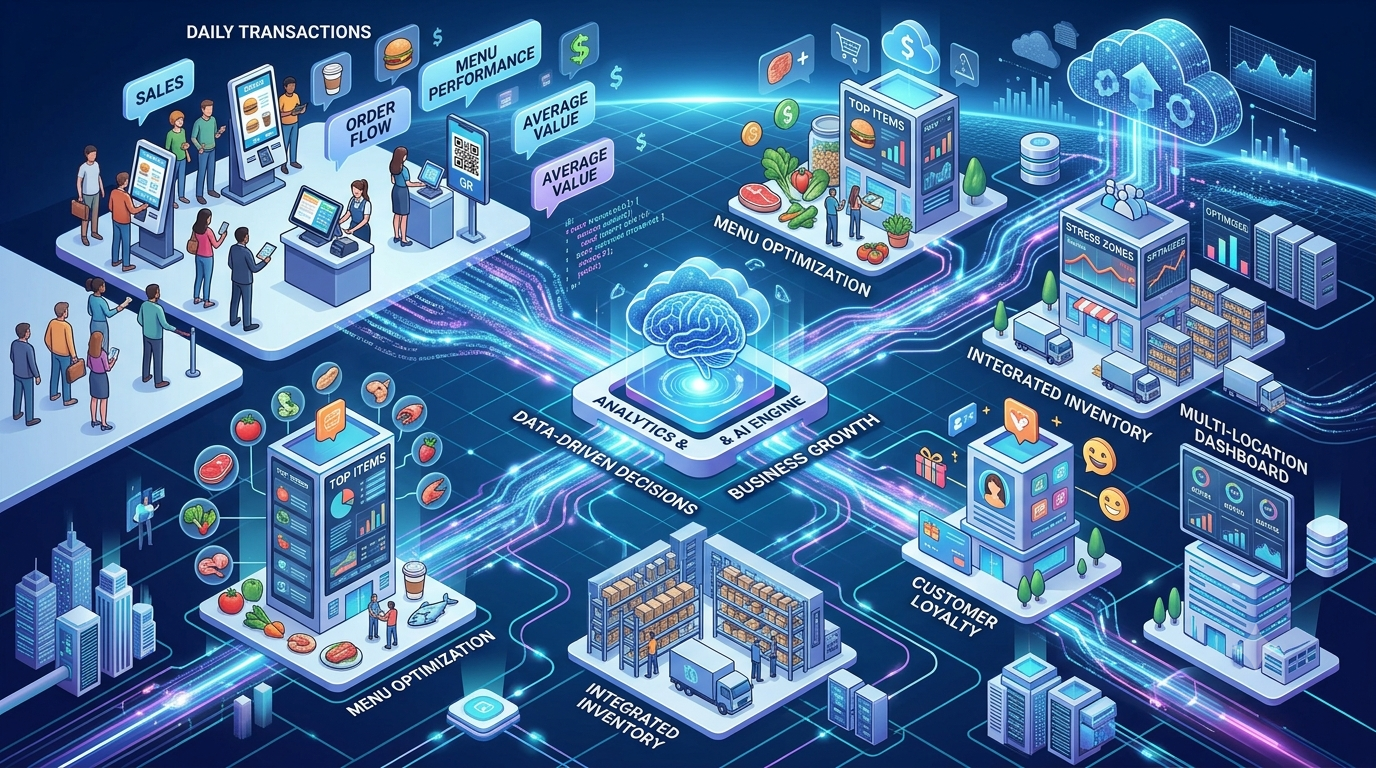
A restaurant POS system does much more than process payments and print receipts.
Every day, a restaurant generates valuable information through orders, menu items, payment methods, discounts, inventory movements, customer visits, peak hours, and employee activity.
When this information is properly connected and analyzed, a POS system can become an important business intelligence platform—not just a billing machine.
Modern restaurants, cafés, QSRs, hotels, cloud kitchens, and restaurant chains are increasingly looking at their POS data to understand what is happening inside their businesses and identify opportunities for improvement.
What Kind of Data Does a Restaurant POS Generate?
A modern restaurant POS can capture information across multiple areas of the operation.
This may include:
- Sales transactions
- Menu item performance
- Order frequency
- Average order value
- Peak business hours
- Payment methods
- Discounts and promotions
- Table utilization
- Inventory movement
- Customer purchases
- Online orders
- Employee activity
- Location-level performance
Instead of keeping this information in separate systems, an integrated POS platform can bring it together in one place.
For example:
Customer → Order → POS → Payment → Inventory → Customer Data → Analytics
This connected workflow can provide management with a clearer view of daily operations.
1. Identify Your Best-Selling Menu Items
Not every menu item contributes equally to restaurant revenue.
POS analytics can help restaurant owners understand:
- Which products sell the most
- Which products generate the highest revenue
- Which items are frequently ordered together
- Which products perform better at specific times
- Which menu items are declining in popularity
This information can support menu planning and promotional decisions.
For example, if a restaurant discovers that a particular combination of products is frequently purchased together, it could consider creating a meal bundle or promotional offer around those items.
2. Understand Peak Ordering Hours
Restaurants often experience significant differences in customer demand throughout the day.
A POS analytics dashboard can help identify busy periods such as:
- Breakfast hours
- Lunch hours
- Dinner hours
- Weekend peaks
- Holiday periods
- Seasonal demand
Understanding these patterns can help businesses plan staffing, inventory, kitchen capacity, and promotions.
For a multi-location restaurant chain, comparing these patterns across outlets can provide additional operational insights.
3. Connect Sales With Inventory
One of the biggest advantages of an integrated POS system is the connection between sales and inventory.
When an item is sold, the associated inventory data can potentially be updated automatically based on the system configuration.
For restaurants, this can help monitor ingredients and products such as:
- Vegetables
- Meat
- Dairy products
- Beverages
- Packaging materials
- Bakery ingredients
- Prepared items
The result can be a more connected workflow:
Sale → Inventory Update → Stock Visibility → Reordering
This can make inventory management more data-driven.
4. Reduce Food Waste Through Better Visibility
Food waste can affect restaurant profitability.
POS and inventory data can help businesses identify patterns around product demand and consumption.
For example, if sales data consistently shows that a particular item has low demand while its ingredients have a short shelf life, management can review:
- Portion sizes
- Menu positioning
- Purchasing quantities
- Promotions
- Preparation schedules
POS data does not eliminate food waste by itself, but it can provide useful information for better operational decisions.
5. Understand Customer Ordering Patterns
Customer data can provide insights beyond individual transactions.
Depending on the POS system and applicable privacy requirements, restaurants may analyze patterns such as:
- Frequently purchased products
- Visit frequency
- Average spending
- Preferred ordering channels
- Loyalty activity
- Response to promotions
This information can help businesses design more relevant customer engagement strategies.
For example, a restaurant could identify customers who frequently purchase a particular category and create targeted promotions around relevant products.
6. Improve Restaurant Loyalty Programs
Loyalty programs become more useful when they are connected directly to purchasing behavior.
A POS-integrated loyalty system can help businesses track:
Customer → Purchase → Points → Reward → Repeat Visit
Restaurants can potentially use this data to understand:
- Most active customers
- Reward redemption patterns
- Repeat purchases
- Customer visit frequency
- Promotional engagement
Instead of treating loyalty as simply a points system, businesses can connect it with broader customer and sales analytics.
7. Compare Multiple Restaurant Locations
Multi-location businesses have another important requirement: centralized visibility.
A restaurant chain may want to compare:
- Sales by location
- Top-selling products
- Inventory movement
- Average order value
- Customer activity
- Peak hours
- Discounts
- Employee performance
- Operational trends
A centralized POS dashboard can bring these metrics together.
Management can then examine individual locations while also looking at overall business performance.
8. Make Promotions More Data-Driven
Discounts can increase sales, but not every promotion produces the same result.
POS analytics can help businesses evaluate promotions based on actual transaction data.
For example:
Promotion A → 500 orders → $X revenue
Promotion B → 300 orders → $Y revenue
The restaurant can then analyze the broader results rather than simply looking at the number of orders.
This can help management understand which promotions are associated with meaningful customer activity and revenue.
9. Connect Online and Offline Orders
Modern restaurants often receive orders through multiple channels.
These may include:
- In-store ordering
- QR ordering
- Restaurant websites
- Mobile applications
- Delivery platforms
- Self-service kiosks
- Counter ordering
If these channels operate independently, restaurant staff may have to manage information across multiple systems.
A connected POS ecosystem can bring different ordering channels into a more centralized workflow.
This can make order management and reporting easier to coordinate.
10. AI Can Add Another Layer of Intelligence
Once a POS system has reliable business data, AI and machine learning can potentially be used to identify patterns.
Examples include:
- Sales forecasting
- Demand prediction
- Inventory recommendations
- Product recommendations
- Customer segmentation
- Anomaly detection
- Automated reporting
- Business trend analysis
For example, historical sales data could be analyzed to identify recurring demand patterns.
AI does not replace restaurant management. Instead, it can help transform large amounts of operational data into useful information.
11. Build Real-Time Management Dashboards
Restaurant owners should not have to wait until the end of the month to understand business performance.
A modern POS dashboard can provide visibility into metrics such as:
- Today’s sales
- Orders
- Average order value
- Best-selling products
- Payment activity
- Inventory status
- Location performance
- Customer activity
For restaurant chains, dashboards can provide centralized visibility while allowing managers to drill down into individual locations.
Custom POS Makes Data More Flexible
Every restaurant operates differently.
A café may focus on fast counter orders.
A fine-dining restaurant may require table management and detailed service workflows.
A QSR may prioritize speed and kitchen routing.
A cloud kitchen may need centralized online ordering and delivery integrations.
A hotel restaurant may require integration with hospitality management systems.
Because of these differences, businesses may require different data structures, workflows, dashboards, and integrations.
Custom POS software can be designed around these specific requirements instead of forcing every business into the same workflow.
What a Data-Driven POS Ecosystem Can Look Like
A modern restaurant technology ecosystem can connect multiple systems:
POS
↓
Orders & Payments
↓
Kitchen / KDS
↓
Inventory
↓
Customer & Loyalty
↓
Accounting / Business Systems
↓
Analytics & AI
This creates a connected technology environment where operational data can move between different business functions.
What Should Restaurant Owners Look For in a Modern POS?
Before selecting or developing a POS platform, businesses should consider:
Scalability
Can the system support additional products, users, locations, and transactions?
Integration
Can it connect with payment systems, accounting software, delivery platforms, loyalty programs, and other business applications?
Analytics
Does it provide useful reporting instead of simply displaying transaction totals?
Security
Can sensitive business and customer information be protected appropriately?
Customization
Can workflows and features be adapted to the restaurant’s requirements?
Mobile Access
Can authorized managers access important business information when they are away from the counter?
Multi-Location Support
Can the system provide centralized management for multiple restaurants?
These considerations become increasingly important as a business grows.
Build a POS Around the Business—not the Other Way Around
A restaurant POS should support the way a business actually operates.
Instead of treating POS software as only a checkout application, businesses can use it as a connected platform for:
- Sales
- Payments
- Inventory
- Kitchen operations
- Customer management
- Loyalty
- Online ordering
- Reporting
- Analytics
- Multi-location management
The right architecture can help turn everyday transactions into useful operational data.
How CustomPOS Can Help
CustomPOS focuses on developing POS solutions for restaurants, cafés, QSRs, hotels, retail businesses, cloud kitchens, and multi-location operations.
Depending on business requirements, a custom POS platform can include:
- Restaurant POS development
- Retail POS development
- Inventory management
- Payment integration
- KOT and KDS integration
- QR ordering
- Online ordering
- Customer loyalty
- Mobile POS applications
- Multi-location management
- Analytics dashboards
- Third-party API integrations
- Custom business workflows
The objective is to build a POS ecosystem around the business’s actual operational requirements.
Final Thoughts
A restaurant’s POS system sees thousands of business decisions every day.
Every order, payment, product, customer interaction, and inventory movement can contribute to a larger picture of how the business operates.
The opportunity is not simply to collect this data.
It is to connect, understand, and use it.
With the right POS architecture, restaurants can move from basic transaction processing toward a more connected, data-driven operating model.
For growing restaurants and multi-location businesses, that can make the POS system an important part of the technology strategy—not just another screen behind the counter.
SEO Keywords
- custom POS software development
- restaurant POS software
- restaurant POS system
- custom restaurant POS
- POS software development
- restaurant management software
- retail POS development
- cloud POS software
- multi-location POS system
- POS analytics
- restaurant inventory management
- restaurant technology solutions
- POS development company
- custom POS developers
Meta Title
How Restaurant POS Data Can Drive Business Growth | CustomPOS
Meta Description
Discover how restaurant POS data can improve sales insights, inventory management, customer loyalty, analytics, and multi-location operations.
Suggested URL Slug
/blogs/restaurant-pos-data-business-growth/
Comments