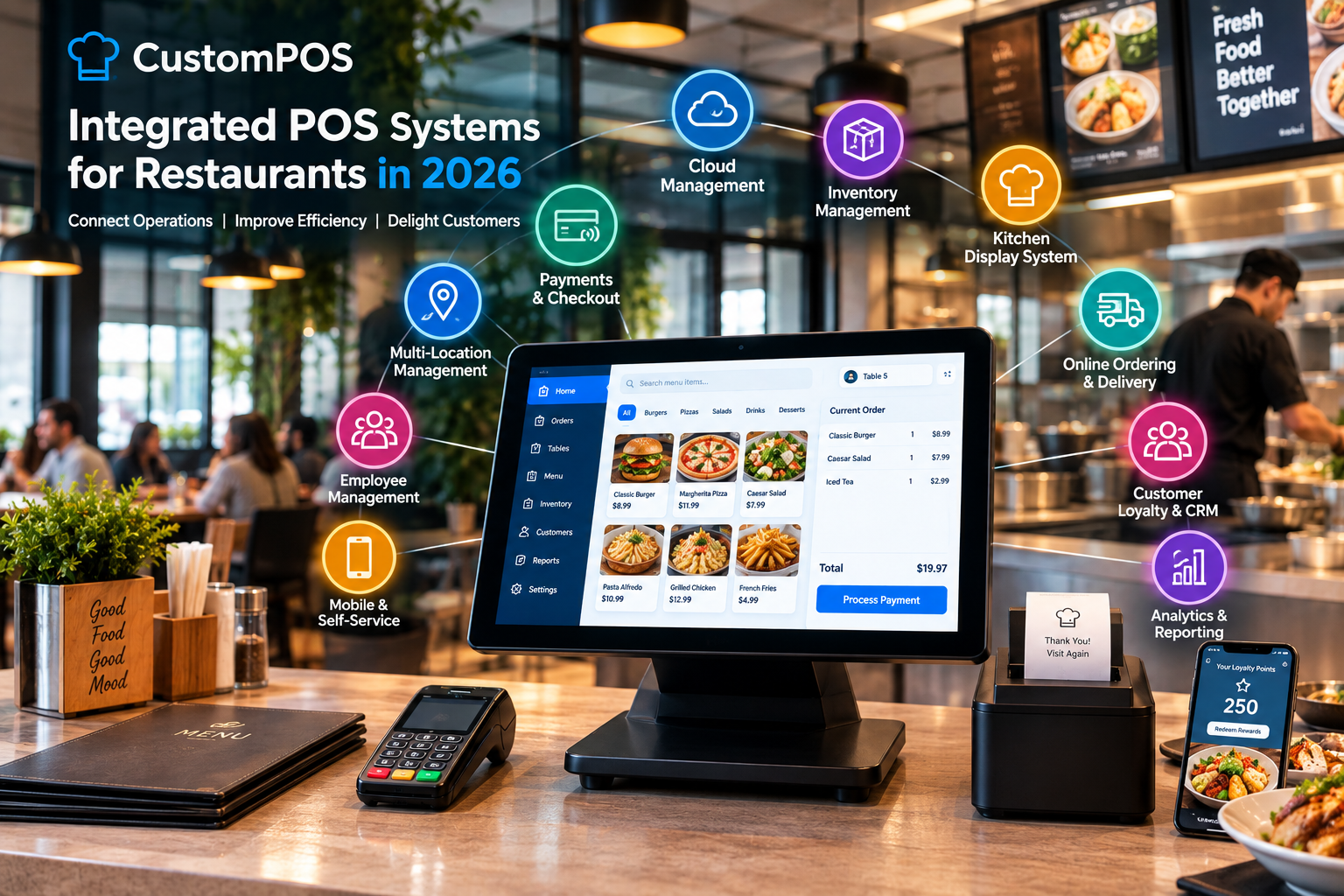
Running a modern restaurant involves much more than taking orders and processing payments.
Restaurants manage tables, menus, kitchen orders, inventory, employees, customer data, online orders, delivery, payments, loyalty programs, accounting, and business reporting every day.
When these operations are managed through disconnected systems, information can become fragmented and employees may spend valuable time moving data from one platform to another.
This is why integrated POS systems for restaurants are becoming increasingly important in 2026.
A modern POS is no longer simply a digital cash register. It can become the central technology platform connecting different parts of a restaurant business.
Industry research shows that strengthening system integration is a major POS priority for restaurants, while a significant portion of operators are also planning to add AI-driven capabilities.
What Is an Integrated POS System?
An integrated POS system connects the point-of-sale platform with other software, hardware, and operational systems used by a business.
Instead of keeping every function separate, restaurants can connect:
- POS billing
- Payment processing
- Inventory management
- Kitchen display systems
- Online ordering
- Delivery platforms
- Customer loyalty
- CRM
- Employee management
- Accounting
- Analytics
- Mobile applications
- Self-service kiosks
- Digital menus
- Multi-location management
This creates a connected restaurant technology ecosystem.
For example:
Customer Order → POS → Kitchen → Inventory → Payment → Customer Data → Analytics
Information can move between different parts of the business without requiring employees to manually enter the same information multiple times.
Why Restaurant POS Integration Matters in 2026
Restaurant operators are under constant pressure to improve efficiency while maintaining customer service.
A disconnected technology stack can create problems such as:
- Duplicate data entry
- Delayed reporting
- Inventory inaccuracies
- Order mistakes
- Payment reconciliation problems
- Poor visibility across locations
- Limited customer insights
- Difficult integration with new services
An integrated POS platform can help create a single source of operational information.
This can give restaurant owners and managers a clearer view of what is happening across the business.
1. Connect Multiple Ordering Channels
Customers now interact with restaurants through multiple channels.
They may order through:
- Restaurant counters
- Tableside ordering
- Restaurant websites
- Mobile apps
- QR codes
- Kiosks
- Delivery platforms
- Online marketplaces
A modern restaurant POS should be able to bring these orders into a centralized workflow.
Instead of employees manually checking several platforms, an integrated system can help route orders to the appropriate operational areas.
This can reduce confusion and improve order visibility.
2. Connect POS With Inventory Management
Inventory is one of the most important areas where POS integration can create business value.
Every completed order contains information about product usage.
When sales and inventory systems are connected, restaurants can gain better visibility into:
- Ingredient usage
- Product availability
- Stock levels
- Popular menu items
- Waste
- Reordering requirements
- Purchasing patterns
For example, if a particular menu item becomes significantly more popular, the restaurant can identify increased ingredient demand and plan inventory accordingly.
This is especially important for restaurant chains managing inventory across multiple locations.
Comments