Introduction
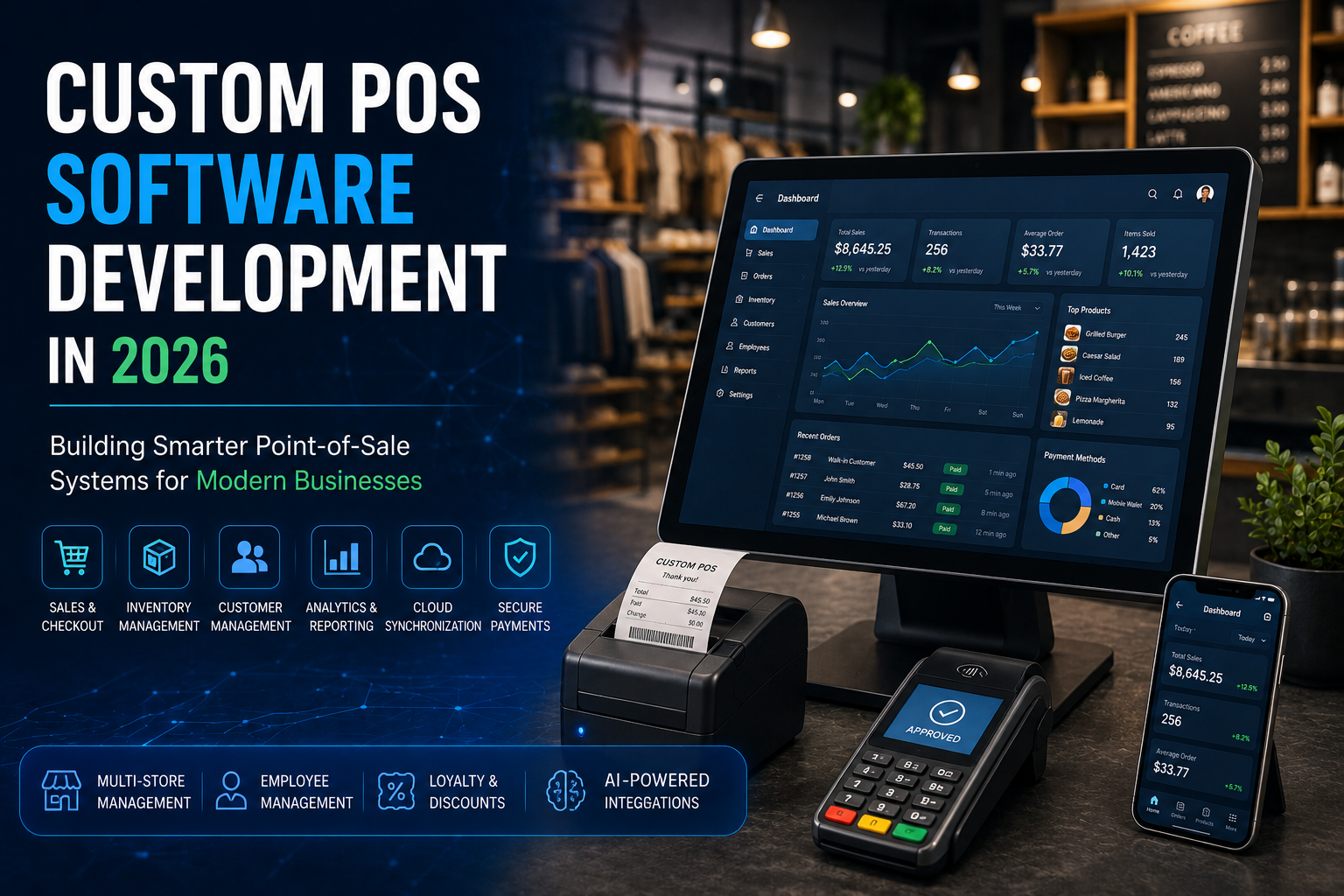
Point-of-sale systems have evolved far beyond traditional cash registers. Modern businesses need POS platforms that can manage payments, inventory, customer information, employees, reporting, and integrations from a single system.
For restaurants, retail businesses, hospitality companies, and multi-location enterprises, custom POS software development can provide the flexibility needed to build a system around specific operational requirements.
In 2026, businesses are increasingly looking for POS platforms that combine cloud technology, mobile applications, analytics, automation, AI, and secure payment processing.
What Is Custom POS Software?
Custom POS software is a point-of-sale system developed specifically for the needs of a particular business or industry.
Unlike an off-the-shelf POS solution, a custom platform can be designed around the company’s:
- Business processes
- Payment requirements
- Inventory structure
- Customer workflows
- Reporting needs
- Hardware ecosystem
- Third-party integrations
- Multi-location operations
This makes custom POS development particularly useful for businesses with complex or specialized requirements.
Why Businesses Are Choosing Custom POS Development
1. Complete Business Customization
Every business operates differently.
A restaurant may need table management and kitchen workflows, while a retail company may require barcode scanning, inventory management, and purchase-order functionality.
Custom development allows businesses to build features around their actual workflows rather than changing their processes to fit generic software.
2. Better Integration
Modern businesses rarely operate with a POS system alone.
A custom POS platform can be integrated with:
- Payment gateways
- Accounting software
- CRM platforms
- Inventory systems
- Loyalty programs
- E-commerce platforms
- Delivery platforms
- ERP systems
- Hardware devices
These integrations can help create a connected business ecosystem.
3. Scalable Architecture
A business may start with one location but eventually expand to multiple stores or restaurants.
Custom POS software can be designed with scalability in mind, allowing businesses to add:
- New locations
- Additional users
- More terminals
- New payment methods
- Additional integrations
- Advanced reporting
This can reduce the need to replace the entire POS platform as the business grows.
Essential Features of Custom POS Software
Inventory Management
A modern POS system should provide businesses with visibility into inventory levels, product movement, stock adjustments, and sales activity.
Automated inventory updates can also help businesses reduce manual work and identify products that need replenishment.
Payment Processing
Secure payment processing is one of the most important components of a POS platform.
Depending on the business model, a POS system may support:
- Credit and debit cards
- Contactless payments
- Mobile wallets
- QR payments
- Online payments
- Integrated payment terminals
Payment architecture should be designed with security and applicable compliance requirements in mind.
Customer Management
Customer data can help businesses build better relationships and personalized experiences.
A custom POS system can support:
- Customer profiles
- Purchase history
- Loyalty programs
- Rewards
- Discounts
- Personalized offers
Employee Management
Businesses with multiple employees can use POS software to manage staff access and monitor operational activity.
Features can include:
- Role-based permissions
- User accounts
- Shift management
- Activity tracking
- Sales performance reports
Reporting and Analytics
Business owners need actionable information rather than raw transaction data.
A custom POS dashboard can provide insights into:
- Daily sales
- Product performance
- Revenue trends
- Customer behavior
- Employee performance
- Inventory movement
- Location-wise performance
AI-Powered POS Systems in 2026
Artificial intelligence is becoming an important part of modern POS platforms.
AI can help businesses analyze transaction data and identify patterns that may otherwise be difficult to detect.
Potential applications include:
- Sales forecasting
- Inventory prediction
- Customer segmentation
- Product recommendations
- Fraud detection
- Automated reporting
- Demand forecasting
For example, a restaurant could use historical sales data to estimate demand for specific menu items during different days or time periods.
Cloud-Based POS Software
Cloud technology has changed how businesses manage POS infrastructure.
With a cloud-based POS system, authorized users can access business information from different locations while maintaining centralized data management.
Benefits can include:
- Centralized reporting
- Multi-location management
- Remote access
- Automatic data synchronization
- Easier software updates
- Scalable infrastructure
Cloud architecture can be particularly valuable for growing restaurant chains and retail businesses.
Custom POS for Restaurants
Restaurants have unique operational requirements that generic POS systems may not always handle effectively.
A restaurant-focused custom POS platform can include:
- Table management
- Menu management
- Kitchen display integration
- Order management
- Split billing
- Discounts
- Multiple payment methods
- Delivery integration
- Customer loyalty
- Inventory tracking
- Multi-location management
Integration between front-of-house, kitchen, payment, and management systems can help improve operational efficiency.
Custom POS for Retail Businesses
Retail businesses can benefit from POS systems that combine checkout functionality with inventory and customer management.
A custom retail POS platform may include:
- Barcode scanning
- Product management
- Inventory tracking
- Purchase orders
- Supplier management
- Customer profiles
- Loyalty programs
- Returns and refunds
- Sales analytics
- Multi-store management
The platform can also be integrated with an e-commerce website to create a more unified sales ecosystem.
Security in POS Development
Security should be considered from the beginning of POS development.
A secure POS architecture may include:
- Data encryption
- Secure authentication
- Role-based access control
- Secure APIs
- Audit logs
- Secure payment gateway integration
- Regular vulnerability testing
- Secure cloud infrastructure
Businesses processing card payments should also evaluate the applicable PCI DSS requirements for their environment.
Custom POS Development Process
A typical development process includes several stages.
1. Requirement Analysis
The development team identifies business workflows, users, hardware, integrations, and required functionality.
2. UI/UX Design
The interface is designed to make common POS tasks fast and easy for employees.
3. Technology Architecture
The development team selects appropriate technologies for the frontend, backend, database, APIs, cloud infrastructure, and integrations.
4. Development
Features are developed and integrated according to the approved architecture.
5. Testing
The platform is tested for functionality, performance, security, compatibility, and usability.
6. Deployment
The POS system is deployed across the required locations, devices, and cloud infrastructure.
7. Maintenance and Updates
After launch, businesses can continue improving the platform with new features, integrations, security updates, and performance improvements.
Why Choose CustomPOS?
CustomPOS can help businesses develop customized point-of-sale platforms designed around their operational requirements.
Custom POS development services can include:
- Restaurant POS development
- Retail POS development
- Cloud POS development
- Mobile POS applications
- Payment integration
- Inventory management
- Customer loyalty systems
- Multi-location POS
- POS analytics
- Third-party integrations
- Custom dashboards
The focus is on building scalable POS technology that can evolve alongside the business.
Conclusion
Custom POS software gives businesses greater control over their sales, inventory, customer, employee, and payment workflows.
As POS technology continues to evolve in 2026, businesses can gain additional value by combining cloud infrastructure, mobile applications, AI-powered analytics, secure payment processing, and third-party integrations.
For businesses with specialized requirements or plans for significant growth, a custom POS platform can provide the flexibility and scalability needed to build a more efficient digital operation.
CustomPOS can help businesses turn their POS requirements into a customized technology solution designed for their industry, workflows, and future growth.
Comments