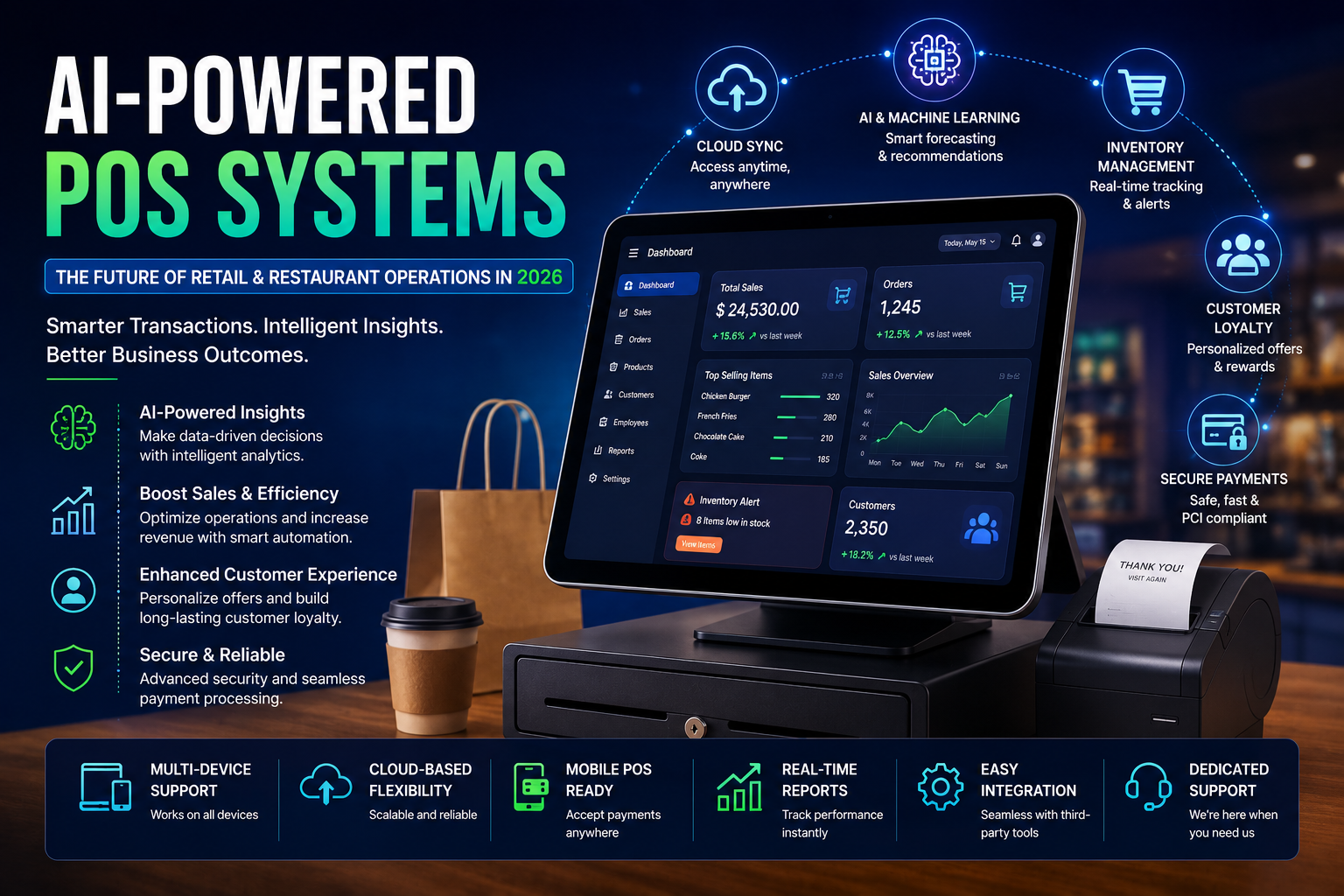
Point-of-sale technology is changing rapidly. A POS system is no longer just a tool for processing payments and printing receipts. In 2026, modern businesses are using intelligent POS platforms to manage sales, inventory, customers, employees, payments, and business performance from one connected system.
Artificial intelligence is adding another layer of intelligence to POS technology. AI-powered POS systems can help businesses identify sales patterns, predict inventory needs, automate routine tasks, personalize customer experiences, and provide useful business insights.
For retailers, restaurants, cafés, franchises, and growing businesses, the future of POS development is focused on creating faster, smarter, more connected, and more flexible systems.
What Is an AI-Powered POS System?
An AI-powered POS system combines traditional point-of-sale functionality with artificial intelligence, automation, analytics, and intelligent recommendations.
A modern AI POS platform may include:
- Payment processing
- Inventory management
- Sales analytics
- Customer relationship management
- Employee management
- AI-powered forecasting
- Automated reporting
- Personalized promotions
- Smart product recommendations
- Fraud and anomaly detection
Instead of only recording transactions, the system can help business owners understand what is happening and support better decisions.
Why Businesses Are Moving Beyond Traditional POS Systems
Traditional POS systems often focus on completing transactions. However, modern businesses need more visibility and automation.
Business owners want to know:
- Which products are selling fastest?
- Which items may run out soon?
- What are the busiest business hours?
- Which promotions are producing results?
- Which customers are likely to return?
- How can staff schedules be improved?
- Where are sales opportunities being missed?
An intelligent POS platform can help answer these questions using real-time data and historical business information.
Top AI-Powered POS Trends in 2026
1. Predictive Inventory Management
Inventory problems can affect revenue and customer satisfaction.
Too much inventory may increase storage costs and waste. Too little inventory can result in missed sales.
AI-powered POS systems can analyze:
- Previous sales
- Seasonal demand
- Product trends
- Sales by location
- Promotion performance
- Supplier lead times
The system can then provide inventory forecasts and suggest when products may need to be reordered.
For restaurants, predictive inventory can help reduce food waste. For retailers, it can help prevent popular products from going out of stock.
2. AI Sales Forecasting
Sales forecasting helps businesses prepare for future demand.
AI can analyze historical sales information and identify patterns that may not be obvious in standard reports.
For example, an AI POS system may identify:
- High-demand periods
- Seasonal changes
- Popular product combinations
- Location-specific sales patterns
- Potential revenue opportunities
These insights can support better purchasing, staffing, and marketing decisions.
3. Personalized Customer Experiences
Customers increasingly expect relevant offers and personalized experiences.
AI-powered POS platforms can use approved customer and transaction data to support:
- Personalized discounts
- Product recommendations
- Loyalty rewards
- Targeted promotions
- Customer engagement campaigns
For example, a café POS system may recommend a loyalty offer based on a customer’s previous purchases.
Businesses should use customer information responsibly and provide appropriate privacy controls.
4. Intelligent Product Recommendations
AI can identify products that are frequently purchased together.
A retail POS system may recommend complementary products during checkout. A restaurant POS system may suggest popular add-ons or menu combinations.
This can help increase average order value while improving the customer experience.
5. Automated Business Reporting
Business owners often spend time preparing sales, inventory, employee, and performance reports.
AI-powered POS systems can automate reporting and highlight important information.
Examples include:
- Daily sales summaries
- Inventory alerts
- Product performance
- Employee sales reports
- Location comparisons
- Customer trends
Instead of reviewing multiple spreadsheets, business owners can access useful insights through a single dashboard.
6. Smart Employee Management
AI and automation can help businesses manage employee operations.
A modern POS system may support:
- Staff scheduling
- Shift management
- Time tracking
- Performance reporting
- Role-based access
Sales patterns can help managers understand when additional staff may be needed.
Employee-related decisions should include human review and consider business policies and local requirements.
7. AI-Powered Fraud and Anomaly Detection
Payment and transaction security are important for every business.
AI can help identify unusual patterns, such as:
- Unexpected refunds
- Unusual transaction amounts
- Repeated voids
- Unusual employee activity
- Suspicious payment behavior
AI-generated alerts can help managers review potential issues more quickly.
AI should support security teams and business controls rather than replace human judgment.
8. Voice-Enabled POS Experiences
Voice technology is becoming more useful in hands-free business environments.
Restaurants and retail teams may use voice-enabled features to:
- Search for products
- Check inventory
- Add items to an order
- Access sales information
- Request business reports
Voice features can improve convenience when designed with accurate recognition and appropriate security.
9. Cloud-Based POS Systems
Cloud POS platforms allow businesses to access data from multiple locations.
Benefits may include:
- Centralized management
- Real-time reporting
- Remote access
- Automatic software updates
- Multi-location support
- Easier scalability
Cloud technology can help businesses manage stores, restaurants, franchises, and distributed teams through one connected platform.
10. Mobile and Contactless POS
Customers expect faster and more flexible payment options.
Modern POS systems may support:
- Mobile POS devices
- Contactless payments
- Digital wallets
- QR code payments
- Self-service checkout
- Online ordering
Mobile POS technology can help employees serve customers away from a traditional checkout counter.
Benefits of Custom AI POS Development
Every business has different workflows.
A ready-made POS system may include unnecessary features or may not support important business requirements.
Custom POS development allows businesses to build solutions around:
- Industry-specific workflows
- Unique pricing models
- Custom inventory processes
- Multi-location operations
- Loyalty programs
- Existing software integrations
- Business reporting requirements
A custom AI POS system can be designed to grow as the business expands.
Custom POS Features Businesses Can Consider
A modern custom POS platform may include:
- Secure payment processing
- Inventory management
- Barcode scanning
- Customer profiles
- Loyalty programs
- Employee management
- Multi-location dashboards
- AI sales forecasting
- Automated reporting
- Mobile POS support
- Cloud synchronization
- Third-party integrations
The right features depend on the business model and customer experience goals.
How to Build an AI-Powered POS System
Step 1: Understand Business Requirements
The development team studies:
- Current workflows
- Customer journeys
- Payment requirements
- Inventory processes
- Employee operations
- Reporting needs
Step 2: Define the POS Architecture
The system architecture may include:
- Mobile applications
- Web dashboards
- Cloud infrastructure
- Payment integrations
- Inventory databases
- AI services
- APIs
Step 3: Design the User Experience
POS software should be fast and simple.
Employees often use POS systems during busy periods, so important actions should require minimal steps.
Step 4: Develop Core POS Features
Developers build payment, inventory, customer, employee, reporting, and business management features.
Step 5: Add AI and Automation
AI features may include:
- Demand forecasting
- Sales insights
- Product recommendations
- Automated reporting
- Anomaly detection
Step 6: Test the System
The POS platform should be tested for:
- Payment reliability
- Performance
- Security
- Usability
- Device compatibility
- Offline functionality
- Data synchronization
Step 7: Launch and Improve
After deployment, the system should be monitored and updated.
Businesses can add new features as customer expectations and operational requirements change.
How to Choose a Custom POS Development Company
Look for a development partner with experience in:
- POS software development
- Payment integration
- Retail and restaurant technology
- Mobile and web applications
- Cloud development
- AI integration
- Data security
- API development
- Long-term software support
The development company should understand the business workflow before recommending a technical solution.
Build Your AI-Powered POS System with CustomPOS Developers
At CustomPOS Developers, we create secure, scalable, and user-friendly POS solutions for businesses across retail, restaurants, hospitality, healthcare, and other industries.
Our services include:
- Custom POS software development
- AI-powered POS solutions
- Retail POS development
- Restaurant POS development
- Cloud POS development
- Mobile POS applications
- Payment gateway integration
- Inventory management systems
- Customer loyalty platforms
- POS software modernization
- POS maintenance and support
Whether you are building a new POS platform, replacing outdated software, or adding AI capabilities to an existing system, our development team can help create a solution designed around your business.
Conclusion
AI is transforming POS systems from transaction tools into intelligent business platforms.
Predictive inventory, automated reporting, personalized customer experiences, sales forecasting, fraud detection, and cloud connectivity are helping businesses make faster and more informed decisions.
The future of POS technology is not only about processing payments. It is about connecting business operations, understanding data, improving customer experiences, and supporting long-term growth.
A custom AI-powered POS system can help businesses build a flexible technology foundation that evolves with their needs.
Ready to build a smarter POS solution? Connect with CustomPOS Developers and turn your business requirements into a secure, scalable, and intelligent POS platform.
Comments